
Some towns try hard to make an impression. Villefranche-sur-Mer does not really try at all.
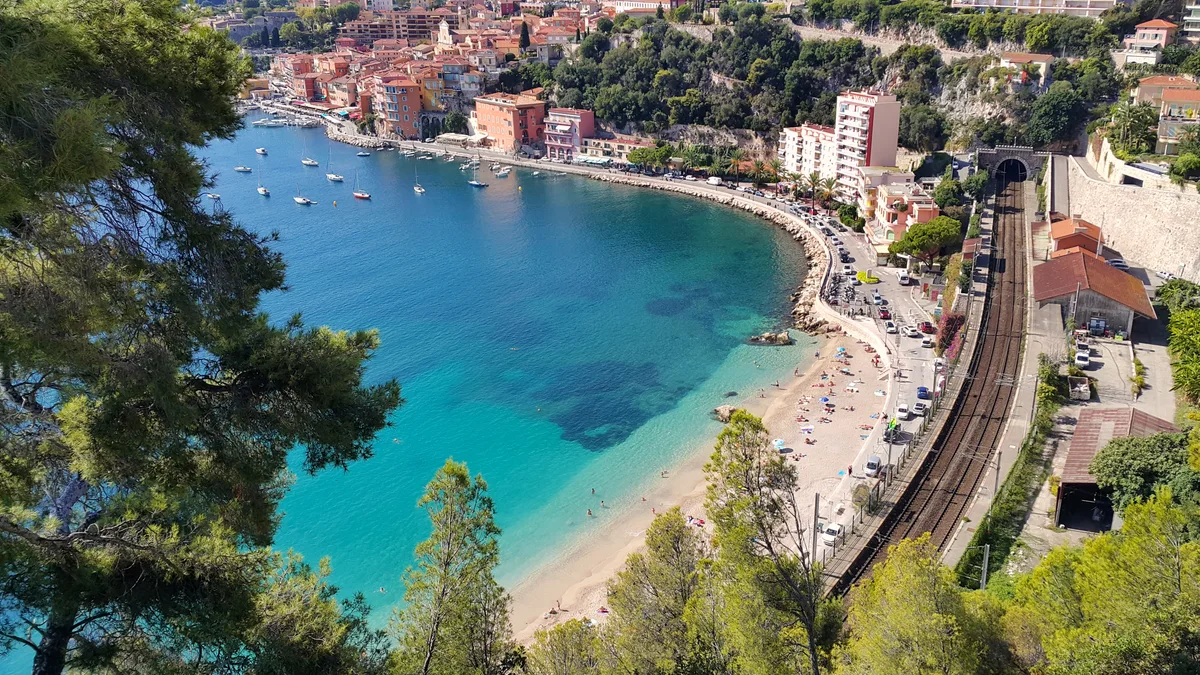
It simply rests between Nice and Cap Ferrat: pink, ochre and yellow houses tumble towards the water, boats rock gently in one of the French Riviera’s loveliest bays, and a genuine medieval labyrinth begins just around the first corner in the Old Town.
And a perfectly reasonable question comes to mind:
“Why haven’t I been here before?”
Villefranche may be small, but its biography is anything but modest: the Dukes of Savoy, naval fleets, corsairs, Jean Cocteau, Grace Kelly and Cary Grant, the Rolling Stones — and a villa whose basement helped make rock ’n’ roll history.
Why Villefranche is called the “free town”
The story of modern Villefranche begins in 1295, when Charles II of Anjou, Count of Provence, founded a new settlement here.
To persuade people to move closer to the sea, residents were offered economic advantages and tax privileges.
Hence the name:
Villefranche — “free town”.
Medieval property marketing worked much like its modern equivalent: if you want new residents, offer attractive terms.
Only here, instead of a swimming pool and parking, the package included one of the Mediterranean’s finest natural harbours.
Villefranche Bay — a natural harbour of extraordinary depth
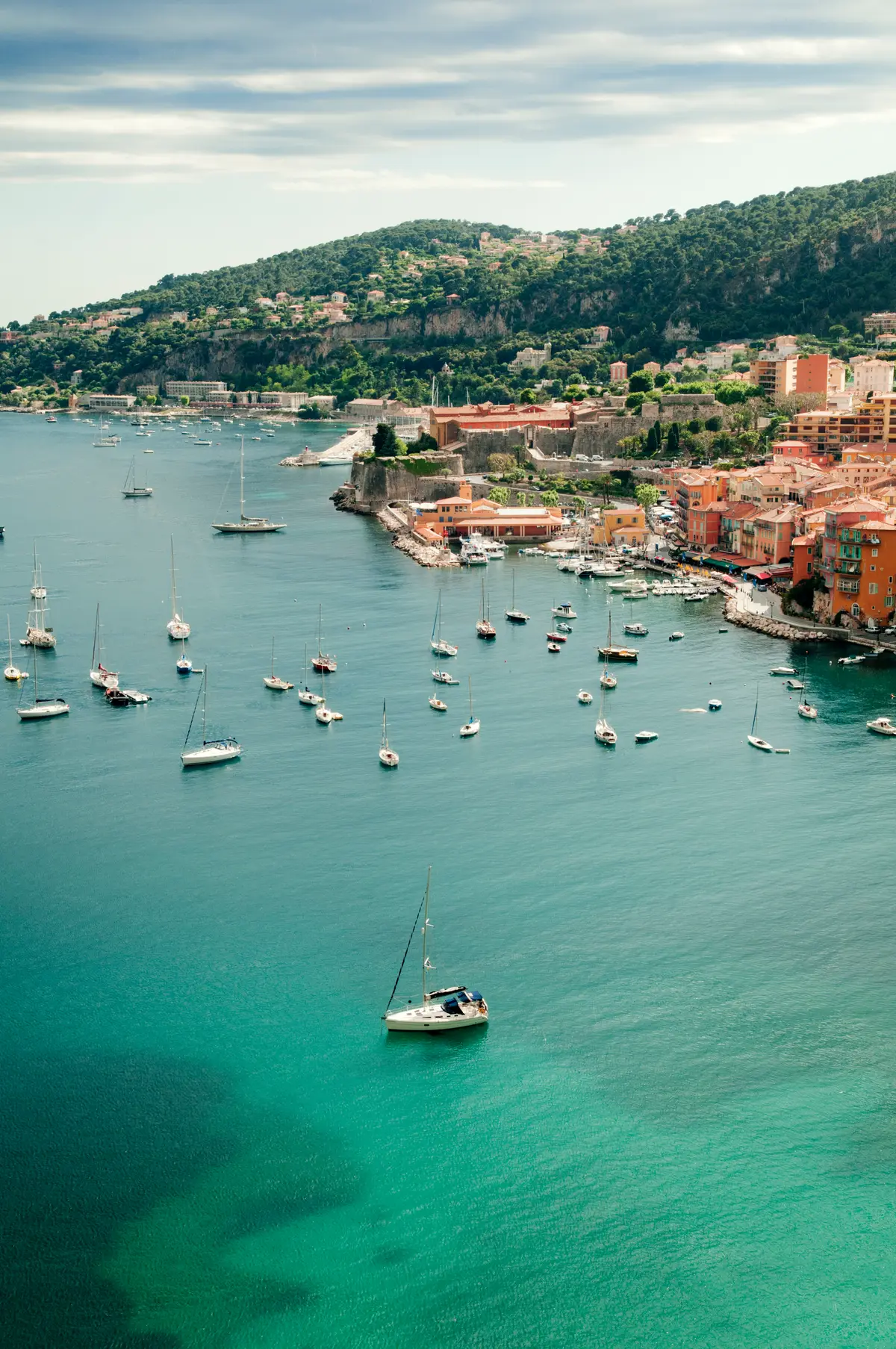

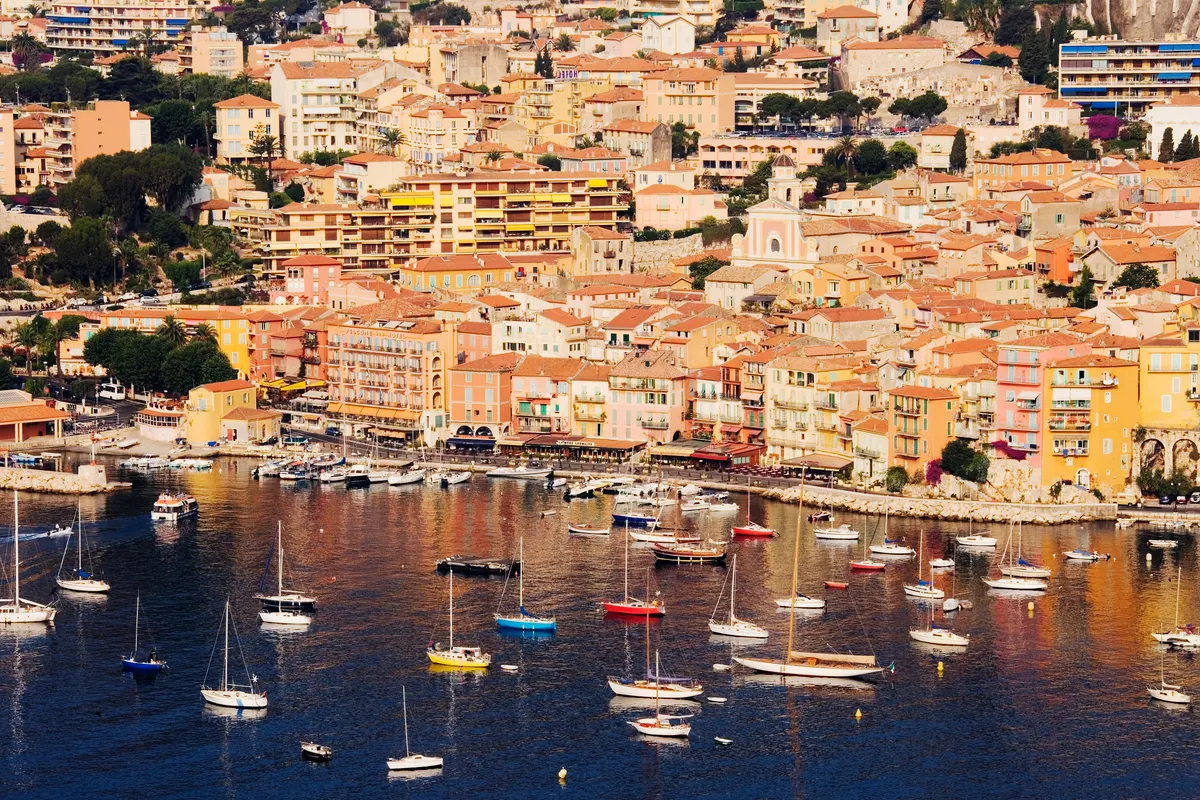
The town’s greatest treasure existed long before the town itself.
The Rade de Villefranche is a large natural bay sheltered by Cap Ferrat and Mont Boron. Considered one of the Mediterranean’s deepest natural harbours, it has attracted warships and merchant vessels for centuries.
That is why Villefranche’s history has always been bound to the sea.
Today, yachts, cruise ships and little fishing boats have taken the place of war galleys.
The scenery has changed.
The sea has barely changed at all.
Rue Obscure — the street where the Middle Ages turned out the lights
The Old Town’s most mysterious spot is Rue Obscure, the Dark Street.
It first appeared in the thirteenth century as a sheltered passage alongside the old fortifications. Over time, houses extended above the street, turning part of it into a proper stone tunnel. People traded here, made their way through town and took refuge from danger.
Today, a few steps are all it takes for the sunlit Riviera to disappear suddenly.
Stone vaults, half-light, curious acoustics.
The perfect place to imagine the Middle Ages.
And to quicken your pace a little if you happen to come in the evening.

The Saint-Elme Citadel — when the Riviera was anything but a holiday destination
In the sixteenth century, Villefranche occupied a position of exceptional strategic importance in the Mediterranean.
Following the attack by the Franco-Ottoman fleet in 1543, Emmanuel Philibert, Duke of Savoy, began fortifying the coast in earnest.
The imposing Saint-Elme Citadel was the result.
Today, soldiers have given way to art, exhibitions, museums, gardens and magnificent sea views.
It is one of those transformations the French Riviera does particularly well:
sixteenth-century military fortress → twenty-first-century cultural space.
La Darse — Villefranche’s secret harbour
A little beyond the tourist waterfront lies a very different Villefranche: Port Royal de la Darse.
This historic harbour was being fortified as early as the sixteenth century and once served as an important naval base for the Savoyard state. Boat-repair workshops still operate here today, maritime traditions endure, and the harbour itself remains wonderfully authentic.
What makes this place especially beautiful is precisely that it does not try to be a stage set.
It smells of the sea, timber, paint and boats.
The real Mediterranean, without a filter.
Saint-Michel Church and a small musical mystery
In the heart of the Old Town stands the Baroque Église Saint-Michel, built in 1757 and now listed as a historic monument.
From the outside, it seems rather restrained.
Inside, however, there is Baroque splendour, gold, painting and a celebrated organ.
It also houses an unusual figure of the recumbent Christ.
After the bright waterfront, the cool silence of the church feels almost like pressing a button:
“Switch off the Riviera for five minutes.”

Jean Cocteau: “Villefranche is my island”
If there was one person who understood Villefranche especially well, it was Jean Cocteau.
A poet, artist, filmmaker and one of the central figures of twentieth-century French culture, he first settled here for an extended stay in 1924. He took a room at the Hôtel Welcome following the death of his close friend, the writer Raymond Radiguet. Cocteau returned to the town many times afterwards.
Villefranche became a place of rest, creativity and encounters with the artistic bohemian world.
Cocteau called it his island.
Almost a century later, the description still feels right.
Chapelle Saint-Pierre — the chapel an artist turned into a work of art
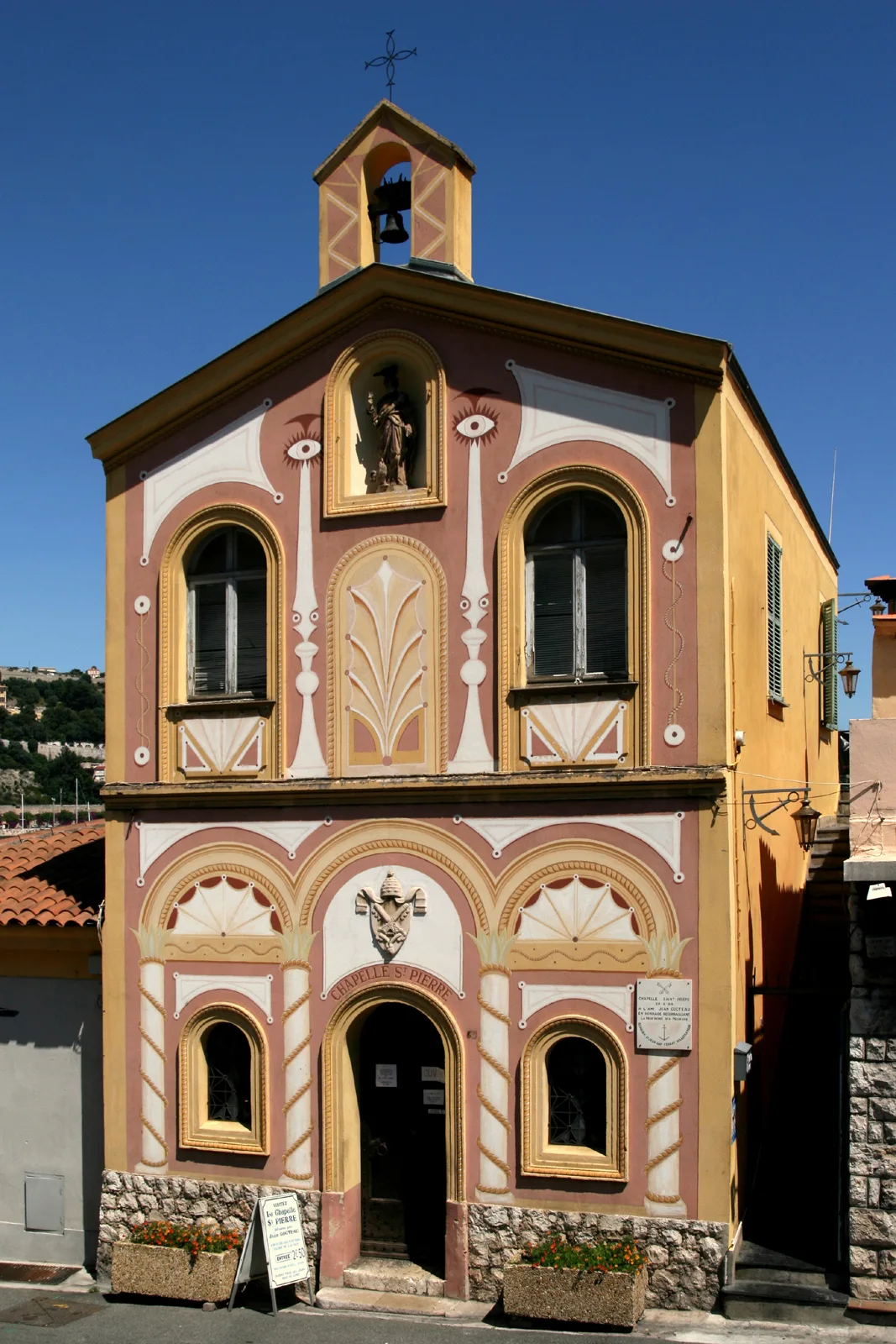
Right beside the harbour stands a small chapel dedicated to Saint Peter, patron saint of fishermen.
From the outside, it is easy to walk straight past.
Don’t.
In 1956, local residents invited Jean Cocteau to decorate the old fishermen’s chapel. He created an entire artistic world: compositions covering the walls and façade brought together biblical scenes, the life of Saint Peter and the everyday lives of Mediterranean fishermen.
This is not a museum into which Cocteau’s works have been placed.
The chapel itself is his work of art.
When the rain helped Jean Cocteau
Villefranche has a wonderful story that proves bad weather can sometimes be good for art.
In 1959, Cocteau was filming Testament of Orpheus. One scene was intended to be shot on the Citadel’s ramparts.
But it started to rain.
The film crew had to move into the covered Rue Obscure.
The gloomy medieval street proved so cinematic that a chance occurrence became part of the film.
Sometimes the director chooses the location.
Sometimes the location chooses the director.
The Rolling Stones and Villa Nellcôte: the Riviera’s most rock ’n’ roll address
And now, from the world of French poetry, straight into rock ’n’ roll.
In 1971, Keith Richards of the Rolling Stones rented the luxurious Villa Nellcôte in Villefranche, a Belle Époque villa built in the late nineteenth century.
The band was living in France as tax exiles at the time.
An improvised studio was set up in the villa’s basement, where the famous sessions for material that would become Exile on Main St. took place.
The villa quickly became a place where musicians, friends, celebrities and guests came and went almost continuously.
By day, the Mediterranean.
By night, the Rolling Stones in the basement.
The neighbours probably enjoyed the most unusual programme of free concerts anywhere on the Côte d’Azur.
Today, Nellcôte is private property and closed to visitors.
But the story lives on.
Was the Gestapo really based at Villa Nellcôte?
An arresting legend surrounds Villa Nellcôte.
Keith Richards spoke of swastikas on the basement ventilation grilles and suggested that German services had used the villa during the Second World War.
The story was so cinematic that it was repeated for decades.
However, there is no reliable evidence that Nellcôte really served as Gestapo headquarters; historical research casts serious doubt on that version of events.
It is a perfect example of how Riviera legends are born:
all it takes is a beautiful villa, a dark basement and one Rolling Stone.
Grace Kelly, Cary Grant and Villefranche on film
Hollywood was also quick to realise that the scenery was ready and waiting.
Villefranche-sur-Mer was used as one of the locations for Alfred Hitchcock’s celebrated To Catch a Thief (1955), starring Cary Grant and Grace Kelly.
There is something particularly fitting about the fact that, soon after filming, Grace Kelly truly became part of this coast’s history: in 1956, she married Prince Rainier III of Monaco.
Villefranche is astonishingly photogenic.
Dozens of films have been shot here, from romances to adventures and action movies.
Perhaps directors simply understood the essential point very quickly:
why build a set when Villefranche already exists?

Artists, writers and people who decided to stay a little longer
Villefranche drew more than filmmakers.
The painter Eugène Boudin, the writers Katherine Mansfield and Aldous Huxley, Jean Cocteau and many other figures of European culture had connections with the town.
Some came for the light.
Some for the sea.
Some for the climate.
And some, perhaps, simply went out for a coffee, looked across the bay and decided:
“All right, then. I’ll stay.”
Why Villefranche’s houses are so colourful
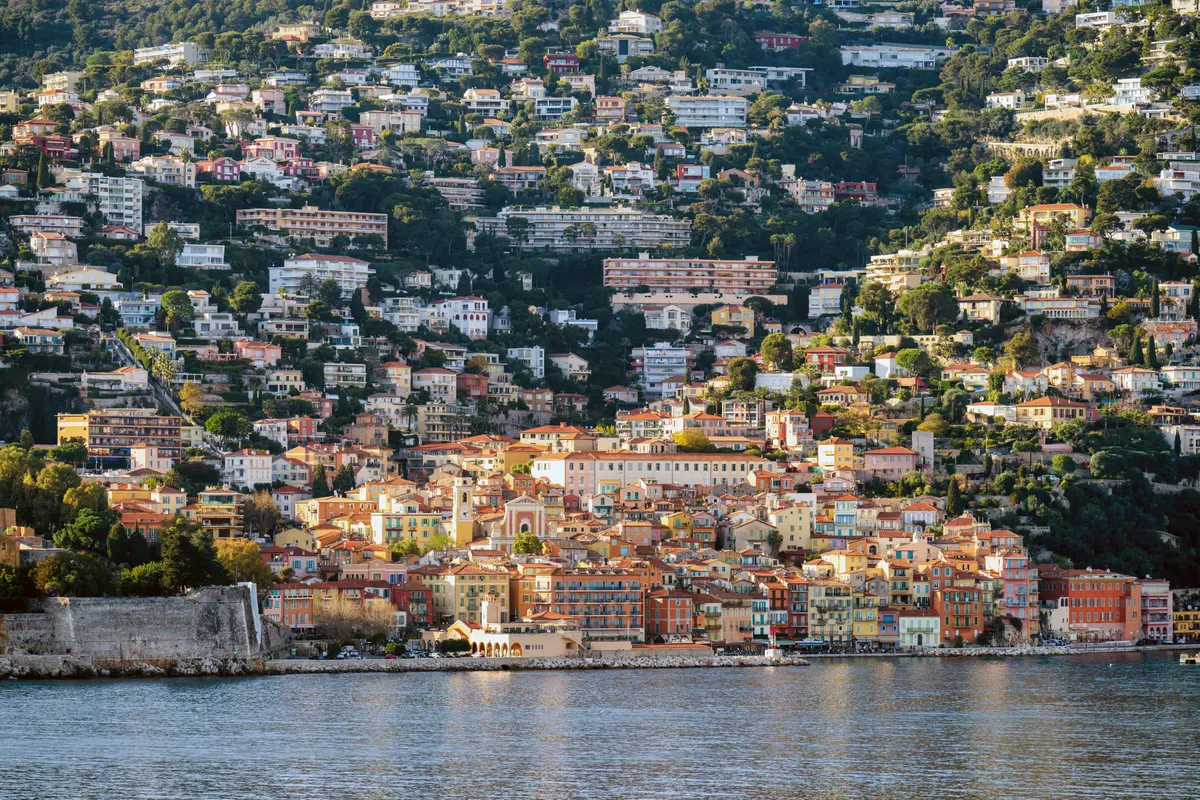
Ochre, pink, yellow and terracotta façades are among the Old Town’s defining visual features.
This is typical Mediterranean architecture of the former territories of the Savoyard state and neighbouring Liguria.
Tall, narrow houses saved space within the defensive walls, while the dense fabric of buildings provided welcome shade in summer.
That is why Villefranche looks particularly striking from the sea:
the colourful façades rise from the water up the hillside like an amphitheatre.
A beach you need not travel far to find
Beside the Old Town lies Plage des Marinières, a long beach at the head of the bay.
The water is often calmer here than along Nice’s open coastline, and the view takes in colourful Villefranche and green Cap Ferrat.
This is the sort of place where a dangerous thought occurs after a tour:
“What if we cancelled our plans for the rest of the afternoon?”
Villefranche, Cap Ferrat and the Rothschild villa in one day

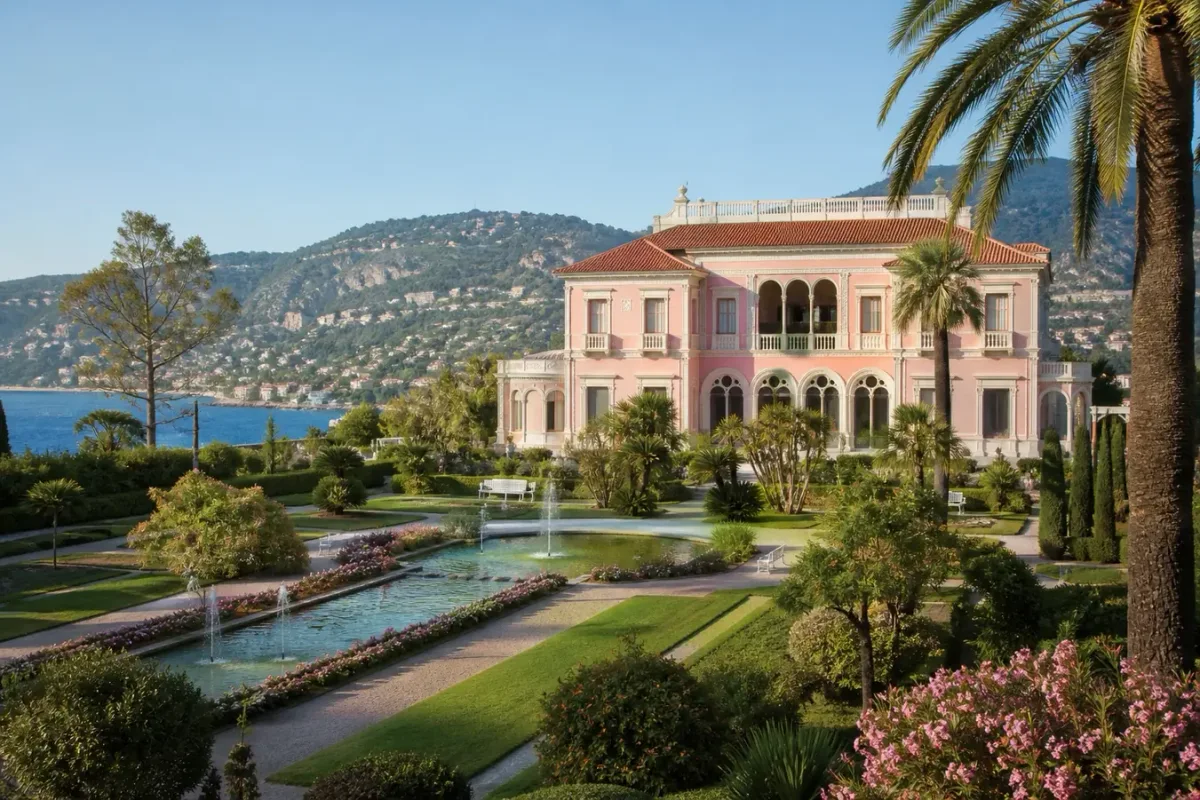
Villefranche combines beautifully in one journey with Cap Ferrat, Villa Ephrussi de Rothschild, Menton and medieval Roquebrune-Cap-Martin.
This is precisely the itinerary brought together in the private “Jewels of the French Riviera” tour: a journey along one of the Côte d’Azur’s most beautiful stretches, from historic villages and panoramic roads to aristocratic villas and Villefranche Bay.
What you must see in Villefranche-sur-Mer
For a first introduction, take in the Old Town, Rue Obscure, Saint-Michel Church, Jean Cocteau’s Chapelle Saint-Pierre, the waterfront, the Saint-Elme Citadel and the historic harbour of La Darse.
Then it is best to stop looking at the list.
Walk down to the water.
Order a coffee.
Watch the boats.
And let Villefranche do what it has been doing for centuries:
persuade you that there is no need to hurry anywhere.
Villefranche-sur-Mer — a small town with a remarkable life story
It is easy to mistake Villefranche for no more than a pretty stop between Nice and Monaco.
That would be a serious mistake.
Beneath the bright façades lies a fortified town. Beneath the medieval vaults are the stories of merchants and sailors. In a little chapel, Jean Cocteau. Behind a villa’s gates, the Rolling Stones. In the bay, centuries of maritime history.
And all of it fits into a town you can walk across in just a few minutes.
Perhaps that is its greatest secret.
Villefranche-sur-Mer does not try to be the loudest place on the French Riviera. It simply remains one of those places you want to return to.